Why Your Loaves Keep Coming Out Flat
Because the spring you're chasing isn't created in the oven. It's built long before that, through the fermentation chain.
You've changed the scoring. Adjusted the steam. Tweaked the hydration. And the next loaf still doesn't rise.
That’s because you’re trying to fix the outcome, not the process that created it.
When a loaf comes out flat, the instinct is to change something physical.
The things you can touch.
The things that give immediate feedback, like pulling a big lever.
You score differently.
You shape tighter.
You change how you steam or bake the loaf.
Those adjustments make sense because they’re visible, hands-on, and happen right before the bake.
What doesn’t feel the same is the slower part of the process.
The part you can’t adjust with your hands.
Where you’re not shaping or scoring, just setting conditions and waiting.
That’s fermentation.
And because its effects only show up much later, in the oven, it’s easy to miss how strongly it can make or break oven spring.
Oven Spring Isn’t a Step. It’s an Output.
Oven spring isn’t something bolted onto the end of the process.
It’s what happens when everything leading up to the bake has been aligned.
By the time the dough goes into the oven, the outcome is already decided.
The oven doesn’t create spring.
It reveals how well the dough was prepared to spring.
That preparation happens across the entire fermentation chain, from starter strength, through bulk fermentation, right through to proofing.
Each stage builds on the last.
When one link is slightly off, the next has to compensate.
When several links are out of balance, the result shows up where you can finally see it, in the oven.
That’s why oven spring feels unpredictable.
You’re seeing the final symptom of a process that unfolded hours earlier.
Why Everything Still Falls Apart in Practice
Even when you understand that oven spring is an output, one problem remains.
In practice, the fermentation chain has to be executed correctly, not just understood.
Starter strength has to be reliable and aligned with the bake.
Bulk fermentation has to carry the dough to the right point of development.
Proofing has to leave the internal structure ready to expand in the oven.
Each of those stages matters on its own.
But if they aren’t executed as one connected process, they don’t line up.
So when oven spring falls short, there’s no clear thread to follow back through the bake, just a result at the end.
That’s where most bakers get stuck.
They know fermentation matters.
They put in the effort.
But without a way to bring everything together in practice, oven spring still feels unpredictable.
The Solution: The Reboot Process
The Reboot process is where oven spring stops being a mystery and becomes predictable.
Not because you learn more theory, but because you finally run the entire process as one connected system.
Instead of treating starter strength, bulk fermentation, and proofing as separate problems to solve, the Reboot brings them together inside a single, simplified baking process.
Starter strength is stabilised and timed to the bake.
Dough weight is matched to the basket so proofing has a clear frame of reference.
Fermentation is tracked as a continuous process, not a series of guesses.
Nothing is added for complexity.
Unnecessary variables are removed.
That’s what makes cause and effect visible.
When oven spring improves, you know why.
And when it doesn’t, you can see exactly which part of the process needs attention.
Why This Approach Produces Oven Spring
Before teaching sourdough to home bakers, I spent years working in professional kitchens.
In that environment, you don’t start with tricks or techniques.
You start with fundamentals.
If the foundation isn’t right, nothing added later will fix it.
So the process begins simple, controlled, and repeatable.
That same approach shaped the Reboot.
I didn’t begin by asking which techniques to include.
I began by asking what was actually required to produce a well-fermented dough with strong oven spring.
A sensible hydration.
A good bread flour.
And correct execution of the fermentation chain.
When those three things are in place, oven spring will follow.
No complex handling is required.
No special techniques are needed.
That’s why the Reboot starts where it does.
It establishes the foundation first, so results are earned through fermentation, not forced through technique.
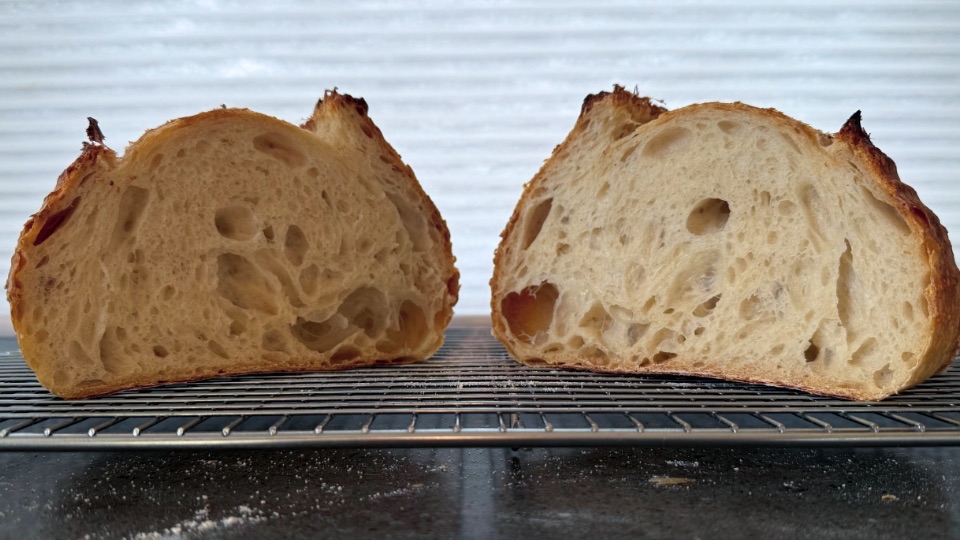
A Real Bake: I Messed Up My Proofing Temperature, And Still Got This Result
"I'm a newbie sourdough baker from New Zealand, and up until now I'd been flying solo with very mixed results.
I just did my first bake using the 800g Reboot recipe, and the result was a revelation. I used the scrapings method to build my levain overnight, then followed the recipe as instructed.
The only hiccup was forgetting to turn on my proofer at the start of the ambient proof.
The result was both a relief and incredibly satisfying."
Mark G, New Zealand
What Happens When You Join
Once you join, you follow a clear, step-by-step system designed to remove guesswork and build reliable results.
Step 1: The Sourdough Starter System
Rehab or stabilise your starter so fermentation is powered correctly from the start.
Step 2: Dough-to-Basket Calibration
Size your dough properly so final proofing becomes measurable, not a guess.
Step 3: Fermentation Chain Fundamentals
Learn to track each stage of fermentation by volume to remove guesswork completely.
Step 4: The Reboot Process
Run controlled bakes that remove variables and lock in consistency.
Step 5: The Sourdough Clinic
Submit real bakes for analysis and learn how to diagnose and fix issues going forward.
How this works as a membership
You use the five steps to build a solid foundation, then continue refining your baking through intentional recipe design, shaping flavour, texture, nutrition, and appearance with each bake.
Progress happens bake by bake, at a pace that fits your life. There’s no fixed schedule and no concept of falling behind.
The membership gives you continued access to the full system and ongoing support as you apply it in your own baking, including Sourdough Lab livestreams where real bakes are analysed and decisions are explored in practice.
The Sourdough Unchained System gives you the framework. The membership is where you apply it, refine it, and build judgment over time.
Want to see exactly what’s included?
You can explore the full curriculum and lesson breakdown below.
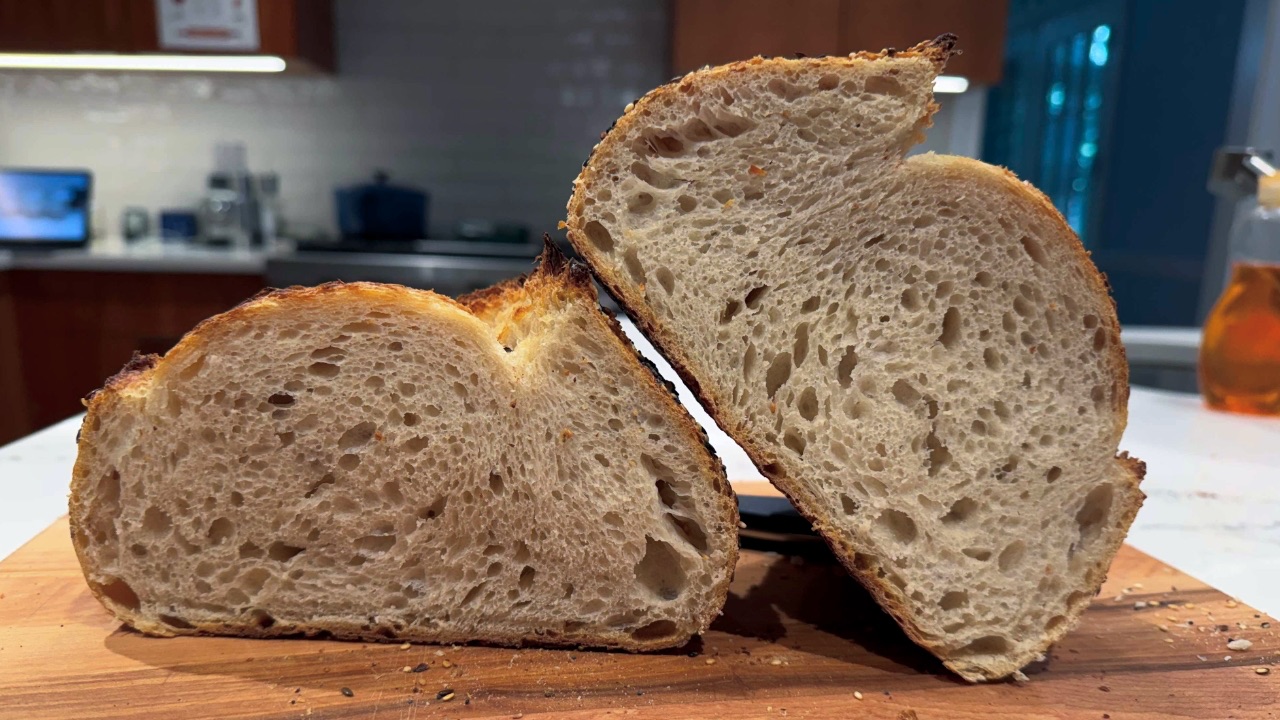
A Real Bake: When the Process Finally Makes Sense
"I’ve cooked and baked for years, but sourdough always felt overwhelming.
I tried to do everything right. Starter ratios, autolyse, stretch and folds, bench proof, cold proof, temperature control. The process became so complicated that I couldn’t tell what was actually helping and what wasn’t.
When I came across Phil’s explanation of fermentation, it immediately clicked. The focus wasn’t on adding more steps, but on getting the foundations right.
I’ve now baked my second Reboot loaf, and for the first time, I feel like I understand how the dough behaves at each stage. The process feels clearer, calmer, and more intentional, and the results are finally starting to follow."
Janet S
Sourdough Unchained Member, Reboot Process
Pictures: Left, early bake. Right, after 2nd Reboot bake

If oven spring still feels unpredictable, this is the step where that changes.
The Reboot is where the entire fermentation chain is finally executed as one process.
Sourdough Unchained Annual Membership
$147/y
Most Popular
Best Value
- $12.25 p/m (billed annually)
- The 5-Step Sourdough System
for mastering fermentation - Personalised feedback on your bake
- Magnus 5 professional recipe calculator
- Monthly live workshops and Q&As
- Sourdough Lounge (members’ HQ)
- 7-day money-back guarantee
Sourdough Unchained Six Month Membership
$99/6m
- $16.50 p/m (billed for 6 months)
- The 5-Step Sourdough System
for mastering fermentation - Personalised feedback on your bake
- Magnus 5 professional recipe calculator
- Monthly live workshops and Q&As
- Sourdough Lounge (members’ HQ)
- 7-day money-back guarantee
You’re not paying for more tips.
You’re paying for a system you can run, bake after bake.
The Complete Sourdough Unchained System – Lesson Breakdown
Oven spring isn’t solved in a single step. It’s the result of the entire fermentation chain being executed in the right order.
Sourdough Unchained is structured so each step builds the conditions required for the next. By the time you reach the Reboot, the foundations are already in place, and the process can finally be run as one connected system.
Step 1: The Sourdough Starter System
Step 2: Dough-to-Basket Calibration
Step 3: The Fermentation Chain Fundamentals
Step 4: The Reboot Process
Step 5: The Sourdough Clinic
Applying the System
Developing Judgment: Expert Conversations
Supporting Tools & Resources
7-Day Money-Back Guarantee
Not satisfied? Get a full refund within 7 days. No questions asked.
You'll get immediate access to everything — The Fermentation Chain, all systems, personalised feedback, and the entire member library.
Try it risk-free. If it's not right for you, we'll refund every penny.
The only risk is continuing to guess when your dough is ready.
Frequently Asked Questions
What if I've never baked sourdough before?
How much time do I need each week?
Do I need special equipment?
How does the personalized feedback work?
What if I’ve tried other courses and I’m still struggling?
Is this worth the investment?
Is VAT included in the price?
Can I cancel anytime?
Is this just videos, or is there interaction?
This Is Where Guesswork Ends and Oven Spring Begins
When oven spring improves, it’s rarely because of a single adjustment. It’s because the entire fermentation chain was executed with intention.
The Reboot gives you a simple process you can run from start to finish, so each bake produces usable feedback.
You’re no longer wondering whether it was the starter, the bulk, the proof, or the timing.
You can see it.
That’s how consistency is built.
Not by adding more techniques, but by running the same process and learning from each result.
7-day money-back guarantee. Cancel anytime.