You’re Not Bad at Proofing.
You’re Just Being Asked to Guess.
The poke test gives you no fixed reference, so proofing turns into a last-minute gamble instead of a confident decision.
The dough is shaped. It’s sitting in the basket.
This is the judgment call that ultimately decides the fate of your loaf.
You press a finger into the dough and watch.
But now you’re stuck.
Did it spring back too fast?
Too slow?
Not enough?
You’ve been told the poke test will tell you when your dough is ready.
And it can, once you’ve built the experience to read it properly.
But most home bakers are using it before they have the experience to decipher it.
So you hesitate.
You second-guess yourself.
Do you wait? Or is it properly proofed?
Not because you don’t care.
Not because you’re careless.
But because you haven’t yet had the time to develop intuition.
And that’s why proofing feels so stressful.
This Is a Common Breaking Point
Proofing is where a lot of bakers lose confidence.
Not because they’ve done anything wrong, but because this is the first time they’re expected to make a call based purely on feel.
When I looked through the thousands of responses and real member bakes in the Home Baker Survey, proofing consistently showed up as a later sticking point. Not at the beginning, but after bakers already had a working starter and a reasonable handle on bulk fermentation.
That pattern wasn’t driven by lack of effort.
It showed up because this judgment is being asked for before intuition has had time to develop.
“I poke it, but I still can’t tell.”
“Sometimes it works, sometimes it doesn’t.”
“I don’t know if I’ve under- or over-proofed.”
“I just don’t trust myself yet.”
When the final decision relies on intuition you haven’t had time to build, hesitation is the natural outcome.
Why Poking Without Reference Doesn't Work
The poke test isn’t lying to you.
The resistance of the dough does change during proofing.
And with enough repetition, those changes start to mean something.
The problem is what you’re being asked to do with that information early on.
You haven’t yet built the link between what the dough feels like now and what the loaf turns into later — oven spring, crumb structure, how the ear opens.
In many cases, that feedback only arrives the next day when you bake.
That’s a big leap for intuition to make without support.
The way out of that loop isn’t to abandon touch.
It’s to stop asking it to carry the entire decision on its own.
When proofing is anchored to something objective, the decision narrows.
Instead of guessing across a wide range, you’re checking whether the dough has reached a known state.
That gets you most of the way there.
The final judgement comes from volume.
Touch becomes a skill you build over time, while volume does the heavy lifting.
This is the role Dough-to-Basket Calibration plays.
It doesn’t replace feel.
It allows you to track proofing accurately using volume, so intuition can build bake by bake instead of through trial and error alone.
The Solution: Turning Proofing Into a Measurable Decision
Dough-to-Basket Calibration is the mechanism that makes this possible.
It gives proofing a fixed reference, so you’re no longer trying to interpret feel in isolation.
Instead of asking “does this feel ready?”, you’re checking whether the dough has reached a known state.
That reference comes from volume.
By calibrating your dough to your basket, you establish how much expansion correctly proofed dough should have before it goes into the oven or the fridge.
Now proofing stops being an open-ended judgment call.
You’re not guessing across a wide range of possibilities.
You’re checking whether the dough has reached the volume you’ve already defined as correct for that bake.
This changes the nature of the decision.
• You know when proofing has progressed far enough.
• You know when it hasn’t.
• And you know when waiting longer would push it too far.
Volume does the heavy lifting.
Touch doesn’t disappear, but it no longer carries the decision.
It becomes something you observe alongside volume, not something you’re forced to trust prematurely.
Over time, feel starts to line up with results.
You begin to recognise what under-proofed dough feels like.
What fully proofed dough feels like.
And what dough that’s already gone too far feels like.
Not in theory, but because you can now connect what you felt at proofing with what you saw in the oven and on the cut.
That’s how intuition actually develops.
Dough-to-Basket Calibration doesn’t rush that process.
It removes the risk while intuition develops.
Why Proofing Breaks Confidence
Before teaching sourdough to home bakers, I spent years working in professional kitchens.
Professional bakers develop feel and intuition through support, training, and repetition.
At home, that intuition develops in isolation, which makes the judgment harder.
As I reviewed thousands of questions and real bakes, a consistent pattern emerged.
By the time bakers reached proofing, most had already solved earlier problems.
Their starter was working.
Bulk fermentation was broadly under control.
And yet, this is where confidence dropped.
Not because proofing introduced a new technique, but because it was the first stage where a clear decision had to be made without a reliable reference.
Proofing isn’t about following another step.
It’s about deciding when to act.
That gap between feel and decision is what Dough-to-Basket Calibration was designed to close.
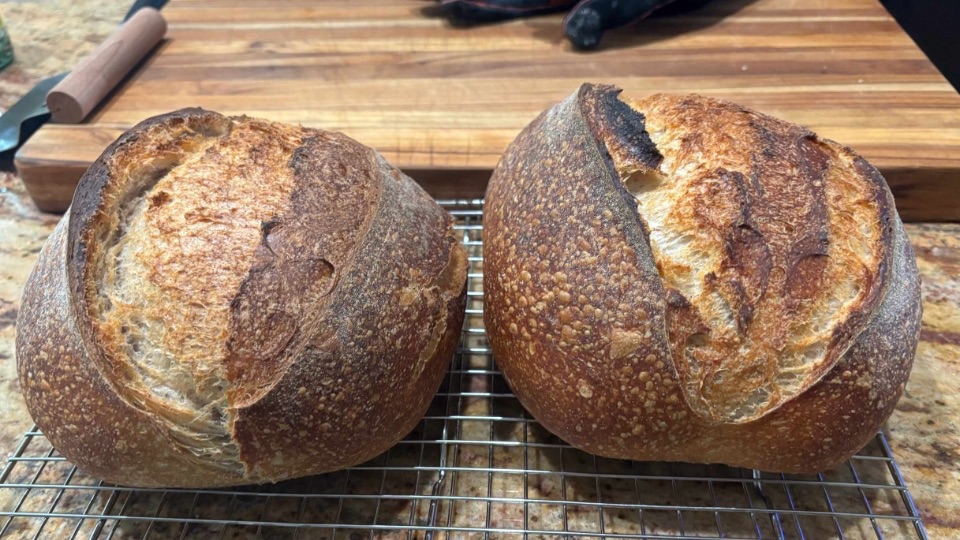
Sizing my dough for my basket was a breakthrough
"Before joining, I was constantly guessing when bulk fermentation was done. Sourdough Unchained taught me how to recognise the end of bulk fermentation with confidence, through guidance and repetition.
Learning to track fermentation through each stage, the levain, bulk, and proofing, gave me a systematic way to judge what was actually happening in my dough.
The real breakthrough came when I learned to size my dough properly for my banneton. Now, bulk fermentation doesn't have to be perfect, just close. Small shortcomings can be balanced out during final proof.
I no longer feel like I'm guessing. I actually know when my dough is ready."
— Kyle M., Texas
What Happens When You Join
Once you join, you follow a clear, step-by-step system designed to remove guesswork and build reliable results.
Step 1: The Sourdough Starter System
Rehab or stabilise your starter so fermentation is powered correctly from the start.
Step 2: Dough-to-Basket Calibration
Size your dough properly so final proofing becomes measurable, not a guess.
Step 3: Fermentation Chain Fundamentals
Learn to track each stage of fermentation by volume to remove guesswork completely.
Step 4: The Reboot Process
Run controlled bakes that remove variables and lock in consistency.
Step 5: The Sourdough Clinic
Submit real bakes for analysis and learn how to diagnose and fix issues going forward.
How this works as a membership
You use the five steps to build a solid foundation, then continue refining your baking through intentional recipe design, shaping flavour, texture, nutrition, and appearance with each bake.
Progress happens bake by bake, at a pace that fits your life. There’s no fixed schedule and no concept of falling behind.
The membership gives you continued access to the full system and ongoing support as you apply it in your own baking, including Sourdough Lab livestreams where real bakes are analysed and decisions are explored in practice.
The Sourdough Unchained System gives you the framework. The membership is where you apply it, refine it, and build judgment over time.
Want to see exactly what’s included?
You can explore the full curriculum and lesson breakdown below.
Once dough size and proofing were linked, everything changed.
In the short time I’ve been part of the community, I’ve benefited hugely.
Choosing the dough weight to match the banneton was vital, something I’d never thought about before. My proofing had been hit and miss, miss, miss.
Another key lesson was starting the dough when the levain was truly ready. I’d never measured its rise and had almost certainly started many bakes with an unready levain.
Thanks to that, my first three bakes have been picture perfect (ignoring the one with the mouse abode). The oven spring and ear shape fill me with pride. I’m now sending bread photos to friends, who roll their eyes and wonder what I’ve been smoking.
Obviously bitten by the bug.
Phil Thomas
Sourdough Unchained Member
This is about replacing guesswork with a reference you can trust.
So proofing becomes a decision you can make with confidence.
Sourdough Unchained Annual Membership
$147/y
Most Popular
Best Value
- $12.25 p/m (billed annually)
- The 5-Step Sourdough System
for mastering fermentation - Personalised feedback on your bake
- Magnus 5 professional recipe calculator
- Monthly live workshops and Q&As
- Sourdough Lounge (members’ HQ)
- 7-day money-back guarantee
Sourdough Unchained Six Month Membership
$99/6m
- $16.50 p/m (billed for 6 months)
- The 5-Step Sourdough System
for mastering fermentation - Personalised feedback on your bake
- Magnus 5 professional recipe calculator
- Monthly live workshops and Q&As
- Sourdough Lounge (members’ HQ)
- 7-day money-back guarantee
You’re not paying for tips.
You’re learning how to make the right call at the moment it matters.
The Complete Sourdough Unchained System – Lesson Breakdown
Proofing is only one decision in the fermentation chain. Sourdough Unchained is organised so that by the time you reach it, you already have the references you need to judge it properly.
Step 1: The Sourdough Starter System
Step 2: Dough-to-Basket Calibration
Step 3: The Fermentation Chain Fundamentals
Step 4: The Reboot Process
Step 5: The Sourdough Clinic
Applying the System
Developing Judgment: Expert Conversations
Supporting Tools & Resources
7-Day Money-Back Guarantee
Not satisfied? Get a full refund within 7 days. No questions asked.
You'll get immediate access to everything — The Fermentation Chain, all systems, personalised feedback, and the entire member library.
Try it risk-free. If it's not right for you, we'll refund every penny.
The only risk is continuing to guess when your dough is ready.
Frequently Asked Questions
What if I've never baked sourdough before?
How much time do I need each week?
Do I need special equipment?
How does the personalized feedback work?
What if I’ve tried other courses and I’m still struggling?
Is this worth the investment?
Is VAT included in the price?
Can I cancel anytime?
Is this just videos, or is there interaction?
Stop Guessing. Volume Track Proofing With Accuracy
When the dough is sized correctly, and proofing is tracked by volume, the decision becomes clear.
You’re no longer asking “Does this feel ready?”
You’re checking whether the dough has reached a known state.
Volume does the deciding.
Touch becomes something you learn from, not something you have to trust blindly.
That’s how confidence builds, bake by bake, without gambling on intuition you haven’t had time to develop.
7-day money-back guarantee. Cancel anytime.